
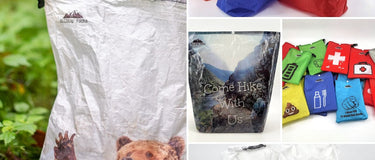
Here is the uncomfortable truth about dry bags: a lot of them are sold on a promise nobody tests until it is too late. You find out whether yours works at 11pm, in a downpour, three miles from the car, when you pull out a quilt that is either dry or very much not.
We build ours in a shop in Waynesburg, Pennsylvania, which means we have cut, sewn, taped, and occasionally ruined enough of them to know where they fail. Seams. Closures. People rolling the top over once and calling it good. None of it is complicated once someone walks you through it, and most of it never gets explained because it is easier to show you a photo of a waterfall.
So this is the whole thing, laid out plain. What size you actually need, what the fabrics really do, what "waterproof" means and where that word gets stretched, and how to pick a bag that fits your trip and your budget. Some of what follows will talk you out of spending more money with us. That is fine. We would rather you buy the right bag once.
What a dry bag is actually for
A dry bag is a roll top bag that keeps water out and keeps one category of your gear together. Quilt in one, clothes in another, electronics in a third, and suddenly you are not excavating your entire pack to find a headlamp. The water part gets all the attention, but the organizing part is the reason most people end up carrying four or five of them.
The big difference from a stuff sack is the closure. A stuff sack closes with a drawstring, which is a gathered hole, so it holds gear but does not seal it. A dry bag closes with a roll top and a buckle, which is what actually keeps the weather out. We wrote a whole post on dry bags vs stuff sacks if you want the full comparison, and our stuff sack guide covers the drawstring side. The short version: anything that ruins your trip if it gets wet goes in a roll top.
Our ultralight dry bags range from a bag that holds a stove and a lighter to one that swallows a winter quilt, and the D50T ones weigh between half an ounce and a little over an ounce and a half.
Waterproof vs water-resistant, and why the word matters
Here is where a lot of marketing gets loose, so we will be blunt. Waterproof is a spectrum, and the fabric is only half of it. The other half is the seams and the closure.
Fabric. Every dry bag fabric we use is waterproof on its own. Water beads up and rolls off.
Seams. A seam is a row of needle holes, and needle holes leak. Our D50T and Dyneema dry bags have taped seams, which seals those holes from the inside. Our budget SmartPack bags use a waterproof nylon that cannot be seam taped, so the seams are double folded and stitched over instead. That is highly weather resistant, but we do not call it fully waterproof, and neither does the product page.
Closure. A roll top only seals if you roll it right. More on that next.
The honest bottom line: a taped seam roll top bag handles rain, splashes, a wet pack bottom, and a stumble at a creek crossing. Treat it as weatherproof gear, not dive gear. We do not rate any of our dry bags for boating or long submersion, and if a brand tells you theirs are "submarine proof" you should ask who tested that.
Roll top closures: how many folds you actually need
This is the part people get wrong, and it is the most common reason a good bag fails. Three steps, in order:
1. Squeeze the air out first. Air in the bag fights the roll and makes the seal looser. It also makes the bag a balloon in your pack.
2. Flatten the top and fold it over at least three times. Not one, not two. Three or more. Keep the fold tight and flat so the edge does not spiral open.
3. Clip the buckle and give it a tug. The buckle holds the roll closed. It is not the seal.
Two folds and a buckle will keep out a drizzle. Three or four will keep out a lot more. If you are overfilled and cannot get three folds, go up a size. A bag you can only roll once is not a dry bag, it is a hopeful bag.
What size dry bag do you need?
People almost always buy too big or too small, and both cost you. Too big and gear shifts around and wastes space. Too small and you cannot get three folds in the top. Here are the sizes in our ultralight D50T roll top dry bag, with real weights and what each one holds:
| Size | Dimensions | Volume | Weight | Price | What it holds |
|---|---|---|---|---|---|
| Small | 5 x 8" | 0.6 L | 0.46 oz | $11.40 | Stove, lighter, med kit, small items |
| Medium | 7.5 x 10.25" | 2.5 L | 0.71 oz | $15.90 | Toiletries, ditty bag, electronics |
| Medium Long | 7.5 x 14.5" | 3.5 L | 0.83 oz | $17.60 | Bigger ditty bag, lightweight clothing |
| Large | 11 x 16.5" | 7.5 L | 1.23 oz | $24.20 | A typical clothing bag |
| Jumbo | 12.25 x 22.25" | 11 L | 1.46 oz | $29.80 | Winter clothes, or a lightweight quilt rated 50 to 20 degrees |
| Jumbo Plus | 13.5 x 23.5" | 15 L | 1.62 oz | $34.40 | A lightweight quilt rated 30 to -20 degrees |
For a quilt or sleeping bag: a 50 to 20 degree quilt fits a Jumbo. A 30 to -20 degree quilt wants the Jumbo Plus. Lighter quilts leave extra room for clothes, which is a nice bonus. Do not compress it hard just to make it fit. You want to be able to roll the top three times.
For clothes: a Large is the classic clothing bag. If you are packing cold weather layers, step up to a Jumbo.
For electronics and small stuff: a Small or Medium. A small dry bag is the best eleven dollars you will spend on your phone, battery, and headlamp.
Not sure which size? Tell us what you are carrying and we will sew one that fits. It is one of the perks of buying from the people who make them.
Fabrics: D50T, Dyneema, and SmartPack nylon
Three fabrics, three different jobs. None of them is the "right" one. It depends on what you value.
D50T (our all-around pick). A tough, ultralight, waterproof sailcloth with taped seams. It is the best balance of weight, durability, and price, and it is what most of our hikers end up buying. If you only read one section of this guide, read this one: start here.
Dyneema (the featherweight pro option). Genuine Dyneema Composite Fabric dry bags are the lightest and the toughest we make, with taped seams, and they come in a lighter 1.0 oz and a heavier 1.43 oz thickness. The tradeoff is price, $29.95 for a Small up to $74.95 for a Jumbo Plus. We would not tell most weekend hikers to buy one. If you are a gram counter, or you want something to carry on the outside of your pack for years, it is worth it. Dyneema supply has been bumpy, so colors and thicknesses shift, and what is in stock changes. For a deeper comparison, see our D50T vs DTRS75 vs Dyneema breakdown.
SmartPack nylon (the budget pick). Our SmartPack dry bags use a waterproof 70D PU-coated nylon ripstop and cost $12 for a Medium Long, $16 for a Large, and $22 for a Jumbo Plus. They are a solid choice for car campers, weekend warriors, and anyone who wants to save money. The honest limits: the seams are double folded and stitched rather than taped, and they are not for submersion or boating. For a thru hike, go with D50T or Dyneema.
Dry bags that do double duty
A dry bag is useful in more places than the bottom of your pack.
The dry bag fanny pack. If you want your phone, snacks, and sunscreen up front where you can reach them, a roll top fanny pack is a dry bag you wear. Our Ultralight Roll Top Fanny Pack is sewn from recycled Ecopak fabric and closes with a roll top, the same idea as any other dry bag.
The pack liner. If you keep running out of dry bags, the thing you may actually want is a pack liner, which is one big waterproof bag that lines your whole pack. We break down when to use each in our pack liner vs pack cover post.
The ditty bag. A small printed bag for your first aid kit, repair kit, or toiletries. Our printed ditty bags are made from the same D50T fabric and make it easy to tell what is what in the dark.
One thing a dry bag is not: a food bag. They are not built to be hoisted into a tree, and they do not have a hanging tab. If you are carrying food in bear country, see our food bags.
Getting yours printed, or a size nobody makes
This is one of the real advantages of buying from a cottage shop. Want your trail name, a photo, or your club logo on a dry bag? We make custom printed dry bags in D50T, from a Small at $28.95 up to a Jumbo at $53.95. Need a size that does not exist, like a long skinny one for a tent pole kit? We make custom size bags too. Try getting that from a big box brand.
Why ours are sewn by hand in Waynesburg, Pennsylvania
Every dry bag we sell is cut, sewn, and taped by hand in our shop in Waynesburg, Pennsylvania. Not shipped over from overseas and relabeled. Real people at real machines, in an industry that mostly stopped doing this a long time ago.
That matters for a boring practical reason: when something goes wrong, you can tell us, and the person who can fix it is down the hall. We designed these with hikers, we test them on trail, and if one fails, we want to know. Browse the full lineup of dry bags and pick by what you are actually putting in them.
Dry bag FAQ
Are dry bags actually waterproof?
The fabric is. A roll top with taped seams, rolled at least three times, handles rain, splashes, and a creek stumble. We do not rate any of our dry bags for boating or long submersion. Our SmartPack bags have stitched, double folded seams instead of taped ones, so they are weather resistant rather than fully waterproof.
What size dry bag do I need?
A Small or Medium for small items and electronics, a Large for clothes, and a Jumbo or Jumbo Plus for a quilt. A 50 to 20 degree quilt fits a Jumbo, and a 30 to -20 degree quilt wants a Jumbo Plus.
What is the difference between a dry bag and a stuff sack?
A dry bag has a roll top closure that seals out water. A stuff sack has a drawstring that holds gear but does not seal it. Read our full dry bags vs stuff sacks comparison.
Do I need a dry bag if I already use a pack liner?
A pack liner protects everything at once. A dry bag protects the specific things that must stay dry and keeps them organized. Plenty of hikers use a liner plus a dry bag around their quilt. If you can only buy one, the liner covers more.
How do I keep a dry bag from ripping?
Do not overstuff it, do not drag it across rock, and keep sharp items like tent stakes and trekking pole tips in their own bag. Do not hang it from a tree as a food bag.
Can I get a custom size or printed dry bag?
Yes. We make custom printed dry bags and custom size bags in our Waynesburg shop.
The short version
For most backpackers: a Jumbo D50T for your quilt, a Large for clothes, and a Small for the stuff you cannot afford to get wet. That covers the whole kit for under seventy dollars, and it will outlast most of the other gear in your pack. If you are counting grams, look at Dyneema. If you are counting dollars, look at SmartPack. And if the size you want does not exist, tell us and we will sew it.
Free shipping on orders over $100. Browse all our ultralight dry bags and we will see you on the trail.


