
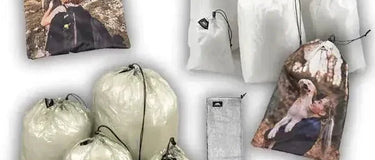
Nobody wakes up excited to shop for a stuff sack. It is the gear you buy so the gear you actually care about stays dry, organized, and not exploding across your tent at 9pm. Get it wrong and it annoys you on every single trip. Get it right and you forget you own it. That second thing is the goal.
The trouble is that "stuff sack" covers a lot of ground. Some are waterproof and some are not. Some squish your gear down with straps and some just hold it. Some weigh almost nothing and some are built like tanks. None of it is complicated once somebody lays it out, which is what we are going to do here.
We sew these by hand in our shop in Waynesburg, Pennsylvania, so we have stuffed, stitched, and field-tested more of them than we would like to admit. Here is everything that actually matters, minus the fluff.
What is a stuff sack, really?
A stuff sack is a soft bag that holds one category of your gear so it stays together and stays findable. That is the whole job. Clothes in one, food in another, first aid in a third, and suddenly you are not excavating your entire pack to find a headlamp.
Three terms get used interchangeably and they should not be:
Stuff sack. Usually a drawstring closure. Holds and organizes. Water resistant at best, because a drawstring is a hole.
Dry bag. A roll top closure with a buckle. Roll it three or four times, clip it, and water stays out. This is the one you trust with your sleeping bag and your down jacket.
Compression sack. A stuff sack with straps that squeeze the contents smaller. Good for bulk, bad for weight, and worse for down than most people realize.
Most of what we make falls in the first two categories. We build ultralight stuff sacks with drawstrings for organizing, and roll top dry bags for the things that must not get wet. Knowing which of those two you need solves most of the decision right there.
What size stuff sack do you actually need?
This is the question we get more than any other, and the honest answer is that people almost always buy too big. A sack with room to spare lets gear shift around, and shifting gear is wasted space in a pack.
Here is a rough guide, using our actual Dyneema sizes as the reference points:
| Size | Dimensions | What it holds |
|---|---|---|
| Small | 4.75" x 6.5" | First aid, electronics, repair kit, toiletries |
| Medium | 7.5" x 11.5" | A day of clothes, socks and base layers, a small food resupply |
| Large | 9.5" x 13.5" | A puffy jacket, a few days of clothes, a full food bag for a weekend |
| Jumbo | 11.5" x 17" | Multi-day food, a bulky layer, camp shoes and extras |
| Jumbo Plus | 13" x 20" | A sleeping bag or quilt, or everything soft you own |
For a sleeping bag or quilt: go one size larger than you think and do not compress it hard for storage. A quilt jammed into a tiny sack every night for a season will lose loft. For the trip itself, a Jumbo or Jumbo Plus is the range. For storing it at home between trips, use a big breathable quilt storage sack and let it sit loose. Compressed storage is what kills down, not the trail.
For clothes: a Medium holds a change of layers for most people. If you are packing for cold weather, size up to a Large so you are not fighting the drawstring in the dark.
For a down jacket: a Large. Puffies compress well but they need room to expand or you will be wrestling it back in every morning.
For food: depends entirely on trip length. Overnight fits in a Large. Anything past two nights, go Jumbo. If you are hanging it, look at a proper food bag instead, since those are built for the abuse of being hoisted into a tree.
One more thing nobody tells you: buy sacks in different colors or prints. Sorting by feel in a dark tent is miserable. Sorting by "the orange one is food" takes a second.
Waterproof stuff sacks vs water resistant
Here is where a lot of marketing gets loose, so we will be blunt.
A drawstring sack is not waterproof. The fabric might be. The closure is a gathered opening with a cord through it, and water goes right through that. A drawstring stuff sack in the rain will keep the worst off your gear for a while. It will not survive a dunk in a creek crossing and it will not save your quilt in a downpour.
A roll top with a buckle is extremely weather resistant, or close enough that the distinction stops mattering. Roll it three or four times, clip it, and you have a real seal. That is why our roll top dry bags exist as a separate product rather than a variation on the same theme.
So the rule is simple. Anything that ruins your trip if it gets wet goes in a roll top. Sleeping bag, insulating layer, electronics, spare socks. Everything else can live in a drawstring sack and be fine.
The other half of this is the pack itself. A lot of people buy a stack of dry bags when what they actually needed was one pack liner, which is a single big waterproof bag that lines the whole pack. Cheaper, lighter, and fewer things to fumble with. We wrote about pack liners versus pack covers if you want the longer argument.
Compression stuff sacks: when they help and when they do not
We do not make compression sacks, so take this as advice rather than a pitch.
They help when you are carrying something bulky and synthetic. A synthetic sleeping bag, a heavy fleece, a bunch of cold weather layers. Compression genuinely buys you pack space there.
They hurt in two situations. First, with down. Down works by lofting, and repeatedly crushing it shortens its life. Compress a down quilt for the trip if you must, but never for storage. Second, on an ultralight setup. Compression straps, buckles, and the heavier fabric they need add real weight, and the whole point of an ultralight kit is not carrying things that do a job a simpler item already does.
If you are counting grams, the better move is a plain drawstring sack and better packing technique. Compression is a solution to a bulk problem, and most bulk problems are actually packing problems.
Fabrics: Dyneema, D50T, and what we sew with
The fabric decides weight, durability, and price, and there is no single right answer.
Challenge D50T is our workhorse. It is a coated ripstop that is tough, highly water resistant, holds a print beautifully, and costs a fraction of Dyneema. Our D50T stuff sacks start at $9.90 for a Small and run to $32.10 for a Jumbo Plus. For most people, for most gear, this is the correct choice and spending more is not going to improve your life.
Dyneema Composite Fabric is the ultralight answer. It is dramatically than anything else at the same strength. It is also expensive. Our Dyneema stuff sacks run $26.95 for a Small to $71.95 for a Jumbo Plus. Worth it if you are chasing base weight or you want your kit to last a decade. Not worth it for a sack that holds your toothbrush.
If you want the real comparisons we put the fabrics side by side on our fabric page. It is the most useful page on our site and almost nobody finds it.
A practical compromise most of our customers land on: Dyneema for the big items where weight adds up, D50T for the small stuff. You get most of the weight savings for a lot less money.
How to actually pack a stuff sack
Three things, and they matter more than which sack you bought.
Stuff, do not fold. For sleeping bags and quilts especially. Folding creates the same crease lines every time and those lines wear out the baffles. Shoving it in randomly distributes the stress. This feels wrong and it is correct.
Do not overfill. A sack packed to bursting becomes a rigid ball, and rigid balls do not fit into the odd-shaped gaps in a pack. A slightly under-filled sack squishes into corners. Squishy beats dense.
Pack in reverse order of need. Sleeping bag at the bottom, since you need it last. Food and layers up top. Sounds obvious, gets ignored constantly, and it is the difference between a two-minute stop and unpacking the whole thing on the side of the trail in the rain.
Why we make ours by hand in Pennsylvania
Almost every piece of ultralight gear you can buy was designed in the US and stitched somewhere far away. We are the stubborn exception. Our sacks are cut and sewn by our own crew in Waynesburg, Pennsylvania, mostly to order, which is why we can do things a factory run cannot.
That includes custom sizes, if what you need does not exist. It includes custom printing, which is how we ended up making tent stake sacks with jokes on them and a chair sack sized to a Chair Zero. And it means when something goes wrong, you are talking to the people who made the thing, not a support queue.
We put our own crew in our photos rather than hiring influencers, because the people making the gear are the interesting part of this business. That is the whole pitch. There is no factory story here, just a shop in southwestern Pennsylvania and a lot of sewing machines.
Frequently asked questions
What is a stuff sack used for?
Organizing gear inside a backpack. One category per sack, so your clothes, food, first aid, and electronics stay separate and findable instead of migrating to the bottom of your pack.
What size stuff sack do I need for a sleeping bag?
For most bags and quilts, our Jumbo (11.5" x 17") or Jumbo Plus (13" x 20"). Size up rather than down, and use a large breathable sack for storage at home so the down keeps its loft.
Are stuff sacks waterproof?
Drawstring stuff sacks are not. The fabric may be water resistant but the closure lets water in. If you need genuinely waterproof, use a roll top dry bag or line your whole pack with a pack liner.
What is the difference between a stuff sack and a dry bag?
Closure. A stuff sack usually has a drawstring and organizes gear. A dry bag has a roll top and a buckle and keeps water out. Different jobs, and most people want some of each.
Do I need a compression sack?
Probably not, unless you are carrying a bulky synthetic sleeping bag or a lot of cold weather layers. They add weight, and they are bad for down over time. Better packing usually solves the same problem for free.
Dyneema or D50T?
D50T for most things, most of the time. Dyneema when weight genuinely matters or you want a sack that outlasts the pack it lives in. Many people mix both.
How do I clean a stuff sack?
Warm water, mild soap, hand wash, air dry. Skip the machine, skip the dryer, skip fabric softener. They do not need cleaning often.
Where to start
If you are building a kit from scratch, the honest starter set is three D50T stuff sacks in different sizes and colors, plus one roll top for anything that must stay dry. That covers ninety percent of people for under fifty dollars.
If you already know you care about weight, start with a Dyneema sack for the biggest item you carry and work down from there.
Either way, browse the full lineup of stuff sacks and pick by what you are actually putting in them. And if the size you want does not exist, tell us and we will sew it.


