
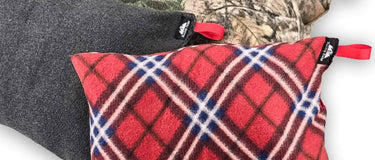
Nobody ever came home from a trip and said, "Wow, I slept great on that rolled-up rain jacket." You lie there at 1am with a zipper pressing into your cheek, your puffy slowly drifting off the pad, and you think about the pillow on your bed at home like it is a long-lost friend.
We are a small crew in Waynesburg, Pennsylvania, sewing ultralight backpacking gear by hand, and we spend a lot of nights on the ground testing it. So we have tried most of the options. The stuff sack full of clothes. The foam lump. The inflatables. Some of them are great. Some of them are a sad balloon by midnight.
This guide is the honest version. What kind of backpacking pillow makes sense for how you sleep, what to look for, how to stop it from sliding off your pad, and when a free stuff sack pillow is all you need. We make a pillow, and we will tell you about it. We will also tell you when you do not need it.
Do you even need a backpacking pillow?
Maybe not. Plenty of people sleep fine with a puffy jacket stuffed in a sack, and if every ounce counts on your trip, that is a perfectly good answer. Back sleepers tend to get away with the least.
Side sleepers are usually the ones who suffer. Your neck wants a few inches of height, and a flat pile of clothes does not give you that after the first toss and turn. If you wake up every trip with a sore neck, a real pillow is probably worth a few ounces. A good night's sleep is the thing that makes mile 14 on day three feel human instead of miserable.
The three kinds of backpacking pillows
Inflatable. This is the lightest option and packs down the smallest. The trade-offs: they can feel bouncy or crinkly, some slide around on a slick pad, and a slow leak means you wake up with your head on the ground. Weight varies a lot by brand, so check the listed number.
Compressible foam or fill. More comfortable than most inflatables, because it feels like an actual pillow. It also weighs more and takes up more room in your pack, even when squished.
A stuff sack full of clothes. Free, already in your pack, and surprisingly good when you do it right (more on that below). The downside is that it depends on how much spare clothing you actually have on a given night.
None of these is "the best" for everyone. The best backpacking pillow is the one that matches how you sleep and how much weight you are willing to carry.
The free option: a stuff sack pillow done right
If you are carrying clothes anyway, you already own a pillow. Here is how to make it a decent one.
- Pick a sack that is big enough. You want it fairly full but not rock hard. Our stuff sacks come in a range of sizes, and our guide on how to choose a stuff sack will help you pick one.
- Stuff it with soft things. Fleece, a spare shirt, your puffy. Keep the pokey stuff (a stove, a headlamp, your phone) out of it.
- Put a soft layer on top. A buff or a t-shirt wrapped around the sack takes away the crinkle of the fabric against your ear.
- Fluff it, then flatten the top. A little shaping goes a long way.
If you want the lightest stuff sack option, our Dyneema stuff sack does the job. For most people, the standard D50T stuff sack is plenty.
What to look for in an ultralight backpacking pillow
- Weight. Be honest about what you will carry. Compare the number on the listing, not the marketing.
- Packed size. Will it fit in your pack without fighting your other gear?
- Surface fabric. Crinkly or slick fabric is the thing most people hate at 2am. Soft fleece or brushed fabric is much nicer against your face.
- Height and shape. Side sleepers need more loft than back sleepers.
- Washability. Trail sweat and sunscreen add up. A pillow you can wash is a pillow you will keep using.
The slippery pillow problem (and three fixes)
The number one complaint about backpacking pillows is that they wander off your pad in the night. Three fixes that work:
- Stuff it in your hood. If your quilt or jacket has a hood, put the pillow under it. Now it moves with you.
- Sleeve it in a sack. A fabric stuff sack around the pillow adds some grip against a slick pad.
- Tuck it under the top edge of the pad. A snug fit keeps it from sliding off the head end.
Backpacking pillow vs. camping pillow
If you drive to the campsite, bring the pillow from your bed. Seriously. Weight and pack size do not matter in a car, and nothing beats the real thing. A backpacking pillow is a different shopping problem: it has to earn its spot in your pack.
Our pick: the RFP Pillow (and why we make it)
We make a pillow called the RFP Pillow. RFP stands for Real Freakin' Pillow, and that is the whole idea. It is not an inflatable. It has a soft fleece outer and a polyester fiber fill, so it feels like the pillow at home, and it never goes flat at midnight.
- Small: 7 ounces (198g), roughly 13.5 x 8.5 inches and 5 inches deep when filled
- Large: 11 ounces (312g), roughly 15.5 x 11 inches and 6 inches deep when filled
- Machine washable in cold water (air dry, do not machine dry), with a hanging tab to dry it
- Sewn right here in Waynesburg, PA
Who it is for: side sleepers, anyone who has given up on inflatables, and people who will happily carry a few extra ounces for a better night.
Who it is not for: if you are chasing the lowest possible base weight, an inflatable will be lighter and smaller. We would rather say so than pretend otherwise.
To carry it, the small pillow fits in a large D50T stuff sack and the large pillow fits in a jumbo. Keep it with the rest of your sleep gear, like our quilt storage sacks.
Getting your pillow printed
The custom printed RFP Pillow is a fun one for trail crews, scout troops, wedding parties, and gifts. Put a logo, a name, or a ridiculous design on it. Browse everything else we print on the custom printed gear page.
Backpacking pillow FAQ
Do you really need a pillow for backpacking?
No, but many side sleepers sleep noticeably better with one. If you wake up with a sore neck on every trip, it is probably worth a few ounces.
Inflatable vs. fiber-filled vs. a stuff sack of clothes: which is best?
Inflatables are lightest. Fiber-filled pillows are the most comfortable. A stuff sack of clothes is free. Pick based on how you sleep and how much weight you will carry.
How do I keep my pillow from sliding off my sleeping pad?
Tuck it under your hood, sleeve it in a stuff sack for extra grip, or wedge it against the top edge of the pad.
Can I use a stuff sack as a pillow?
Yes. Fill it with soft clothes, keep hard items out, and wrap a soft layer around it so the fabric does not crinkle against your ear.
How should I wash a backpacking pillow?
Check the care label. Ours is machine washable in cold water and should be air dried, not machine dried.
Pick what lets you sleep
If a stuff sack full of clothes works for you, great, you are done. If you want a real pillow out there, take a look at the RFP Pillow. Pair it with a couple of stuff sacks and you are on your way to free shipping over $100. Either way, we hope you sleep well out there.


